
Every business starts with a decision that most founders make too quickly: what legal form it should take. The choice between operating as a sole proprietor, forming a partnership, or incorporating a company is not a piece of administrative housekeeping. It determines whether your personal home is at risk if the business fails, how much tax you pay, whether an investor can put money in against shares, and whether a serious client or bank will take you seriously at all. Choosing well at the start is far cheaper than restructuring later, once contracts, assets and tax history have accumulated under the wrong form.
This guide compares the main business structures available in Pakistan and gives you a framework for choosing between them. It is written for founders, family businesses, professionals and overseas Pakistanis planning a venture at home. The relevant laws include the Companies Act 2017, the Partnership Act 1932, the Limited Liability Partnership Act 2017 and the Income Tax Ordinance 2001, with registrations handled by the Securities and Exchange Commission of Pakistan, the Registrar of Firms and the Federal Board of Revenue.
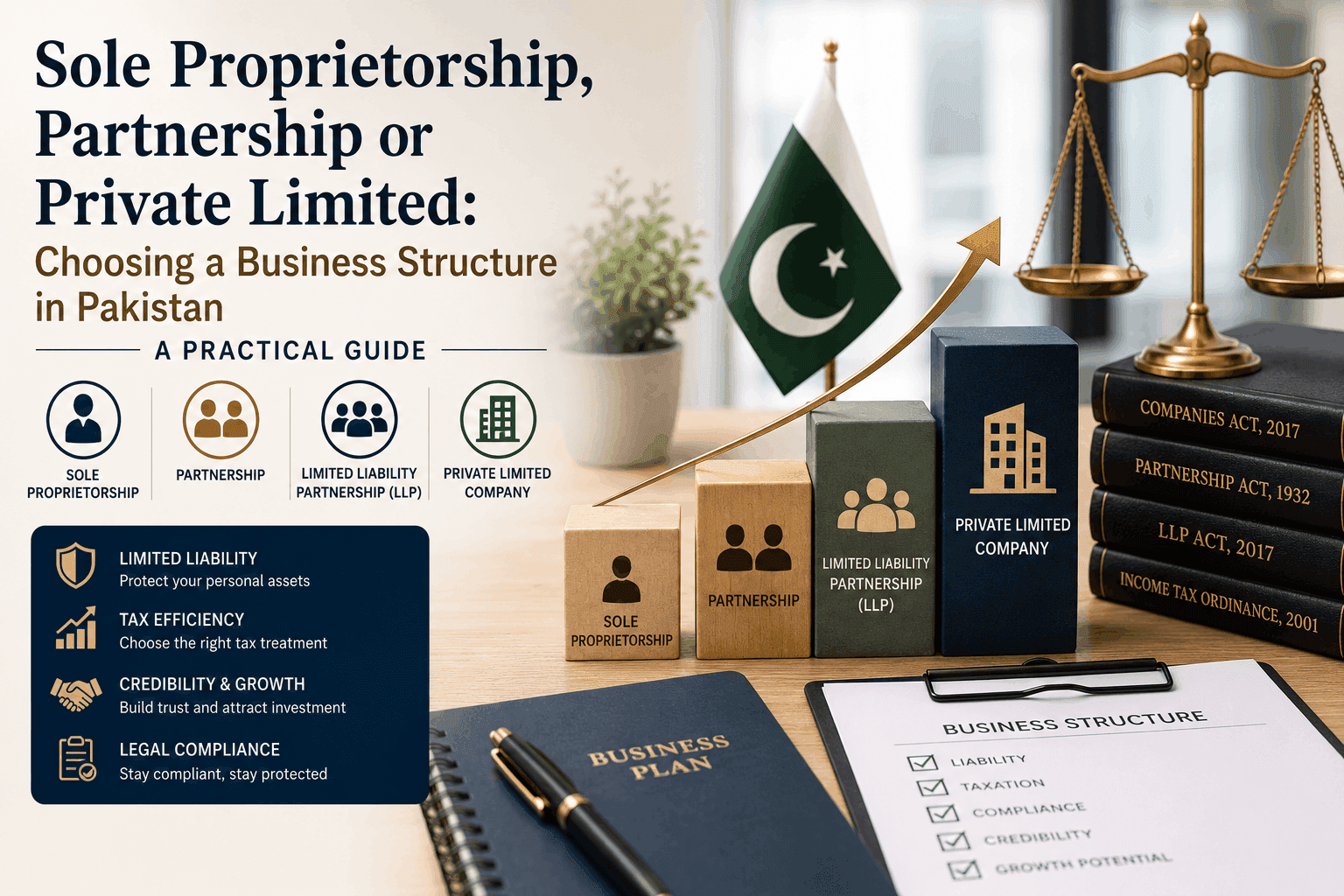
The four structures at a glance
There are four forms most businesses realistically choose between, arranged roughly from simplest to most robust.
- Sole proprietorship: one person trading in their own name or a business name, with no separation between owner and business.
- Partnership (firm): two or more people carrying on business together under the Partnership Act 1932.
- Limited liability partnership (LLP): a hybrid registered with SECP, giving partners limited liability with partnership flexibility.
- Private limited company: a separate legal person incorporated with SECP under the Companies Act 2017, including the single member company for solo owners.
The differences between them come down to a handful of factors that matter in real life: liability, legal identity, tax, compliance, cost, credibility and the ability to raise money. Consider each in turn.
The sole proprietorship
A sole proprietorship is the simplest way to be in business. There is no separate legal entity; the business is legally the same as the person who owns it. You register with the Federal Board of Revenue for a National Tax Number using your CNIC, adopt a business name, open a bank account in the business name on the strength of your tax registration, and you are trading.
The appeal is obvious: it is fast, cheap and lightly regulated, with your business profits simply taxed as your personal income at the individual slab rates. The drawback is equally important and often underestimated. Because there is no separation between you and the business, your liability is unlimited. If the business owes money it cannot pay, creditors can pursue your personal assets, including your savings and your property. A sole proprietorship also cannot bring in a co-owner against a shareholding, cannot easily attract outside investment, and does not continue as an entity beyond its owner. It suits a freelancer, a consultant or a small trader who is not carrying significant risk and does not plan to raise capital, and it becomes a liability, in every sense, once the business grows.
The partnership
A partnership under the Partnership Act 1932 is two or more people carrying on business together with the intention of sharing profits. It is created by agreement, ideally a written partnership deed setting out capital contributions, profit sharing, roles, decision-making and what happens when a partner leaves or the firm dissolves. Registration of the firm with the Registrar of Firms is not strictly mandatory, but it is strongly advisable, because an unregistered firm faces real disadvantages, including a restriction on its ability to sue to enforce contractual rights. For tax, a firm is treated as an association of persons.
A partnership allows people to pool capital and skills more formally than a handshake, but it carries the same fundamental weakness as the sole proprietorship, multiplied. Partners generally have unlimited joint liability, meaning each partner can be exposed to the whole of the firm's debts, and, more uncomfortably, to the consequences of a co-partner's actions taken in the course of the business. A partnership without a proper deed is one of the most common sources of business disputes we see, because everything unstated becomes contested the moment the partners disagree. The partnership can work for professional practices and small joint ventures where the partners trust one another and the risk is contained, but the liability exposure makes it a poor vehicle for a business that intends to grow or take on significant obligations.
The limited liability partnership
The limited liability partnership, introduced by the LLP Act 2017 and registered with SECP, was designed to answer the partnership's central flaw. An LLP is a separate legal entity with perpetual succession, and, crucially, the partners' liability is limited, so a partner is not personally liable for the LLP's debts beyond their agreed contribution, nor for the wrongful acts of other partners in which they were not involved. It combines much of the internal flexibility of a partnership with the liability protection of a company, and it is particularly attractive to professional firms and to ventures with a small number of active participants who want protection without the fuller governance of a company. It sits, deliberately, between the partnership and the private limited company, and for some businesses it is exactly the right middle path.
The private limited company
The private limited company, incorporated with SECP under the Companies Act 2017, is the structure most growth-minded businesses ultimately choose, and often the one they should have started with. A company is a separate legal person. It owns its own assets, signs its own contracts, sues and is sued in its own name, and continues to exist regardless of changes in its ownership. The shareholders' liability is limited to the amount unpaid on their shares, so, in the ordinary case, personal assets are protected from business creditors. For a solo founder, the single member company offers the same protections with one shareholder.
Those features unlock things the other structures cannot offer. A company can raise investment by issuing shares, which is how nearly every funded startup in Pakistan is built. It presents a credible face to banks, large customers and international counterparties, who frequently prefer or require a registered company. It separates personal wealth from business risk, which is the point founders appreciate most when something goes wrong. Companies are taxed at the corporate rate rather than at individual slabs, which has its own planning consequences depending on how profits are used. The trade-off is compliance: a company must maintain statutory registers, file annual returns and financial statements with SECP, meet audit obligations that scale with its size, and keep to a tax compliance calendar. That obligation is real, but it is manageable and, for a business of any ambition, a worthwhile price for limited liability, continuity and access to capital. Our detailed guide on how to register a company in Pakistan walks through incorporation and the first year of compliance.
How to choose: a practical framework
Rather than asking which structure is best in the abstract, ask which fits your specific situation across the following questions.
How much personal risk can you accept?
If the business will owe money, hold inventory, take deposits, sign leases or carry any real chance of a claim, limited liability matters enormously, and that points to an LLP or a company. If you are a solo consultant with negligible liability, a proprietorship may be tolerable, at least to start.
Are there partners or investors?
If ownership is shared, or investment is on the horizon, a company is usually the right answer, because only shares provide a clean, transferable, investable stake, backed by a shareholders' agreement. Trying to bring an investor into a proprietorship or an informal partnership is where structures break down.
How important is credibility?
If you will deal with banks, government, large corporates or foreign clients, a registered company signals permanence and accountability in a way a proprietorship does not, and some counterparties will simply not contract with an unincorporated business.
What is your growth plan?
If you intend to grow, hire, raise capital or eventually sell, start with a structure that supports that, because converting later, while possible, costs time, money and tax complexity that early planning avoids. If the venture is genuinely small and static, a lighter structure may serve.
What compliance can you sustain?
A company's ongoing filings are modest for a small business but they are not zero, and they must be kept up. If you will not maintain them, either commit to outsourcing them or choose a structure whose obligations you will actually meet.
Changing structure later
Businesses frequently outgrow their original form, and the law allows movement between structures, for example converting a proprietorship's operations into a company, or converting a firm. Conversion is workable but rarely seamless: assets and contracts must be transferred or novated, tax registrations updated, employees moved across, and the change managed so that continuity is preserved and no liability is left stranded. The lesson is not that you can never change, but that changing is more expensive than choosing well at the outset, which is why the structure decision deserves proper thought before you sign your first major contract.
Common mistakes
- Defaulting to a proprietorship for a risky business. Unlimited liability is fine until it is catastrophic.
- Partnering without a written deed. An unwritten partnership is a dispute waiting to happen, and an unregistered firm is disadvantaged in enforcing its rights.
- Incorporating without a shareholders' agreement. Equal shareholders with nothing in writing about deadlock and exit is the most expensive gap in Pakistani startups.
- Choosing for today, not for the plan. A structure that cannot take investment or scale forces a costly conversion later.
- Underestimating compliance. Choosing a company and then ignoring its filings invites penalties and undermines the protection you incorporated for.
- Mixing personal and business finances. This weakens both your accounts and, for a company, the limited liability itself.
Frequently asked questions
What is the best business structure in Pakistan?
There is no single best structure; the right one depends on your risk, your ownership, your growth plans and the compliance you can sustain. A solo, low-risk consultant may start as a proprietor, while a business with partners, investors or real liability is usually better as a private limited company or an LLP.
What is the main difference between a sole proprietorship and a private limited company?
A sole proprietorship is not separate from its owner, so liability is unlimited and personal assets are exposed. A private limited company is a separate legal person with limited liability, continuity beyond its owners, and the ability to raise investment through shares, at the cost of more compliance.
Do I need partners to form a company?
No. A single member company allows one person to own a company outright, with the protections of limited liability and separate legal identity, so a solo founder does not need to remain a proprietor.
Is a partnership a good idea?
A partnership can work for trusted co-owners in a contained business, but partners face unlimited joint liability, and an unregistered firm is disadvantaged in enforcing its rights. Many businesses that would once have been partnerships now choose an LLP or a company for the liability protection.
Can I change my business structure later?
Yes, structures can be converted, for example from a firm or a proprietorship's operations into a company. Conversion is workable but involves transferring assets and contracts, updating tax registrations and managing continuity, so it is more costly than choosing well initially.
How are the different structures taxed?
A sole proprietor is taxed on business profits at individual slab rates, a firm is taxed as an association of persons, and a company is taxed at the corporate rate. Because rates and treatment change with each Finance Act, take current advice before deciding on tax grounds.
Key takeaways
- Your business structure decides your personal liability, tax, compliance, credibility and ability to raise money, so choose deliberately.
- Sole proprietorships and ordinary partnerships are simple but carry unlimited liability that grows dangerous as the business grows.
- The LLP and the private limited company provide limited liability and a separate legal identity, with the company also enabling share investment and continuity.
- Choose for your plan, not just for today, since converting later is more expensive than starting right.
- Whatever the form, put the ownership terms in writing and keep personal and business finances separate.
Choose the right structure with HAYStone Legal
HAYStone Legal advises founders, families and overseas Pakistanis on choosing and setting up the right business structure, drafting partnership deeds and shareholders' agreements, and handling SECP and tax registration and compliance. To plan your setup, read about our corporate and commercial practice, use our company registration guide, and book a consultation in person, by Zoom or on WhatsApp. This article is general information about Pakistani law, not advice on your specific business; the right structure depends on your risk, your ownership and your plans.