
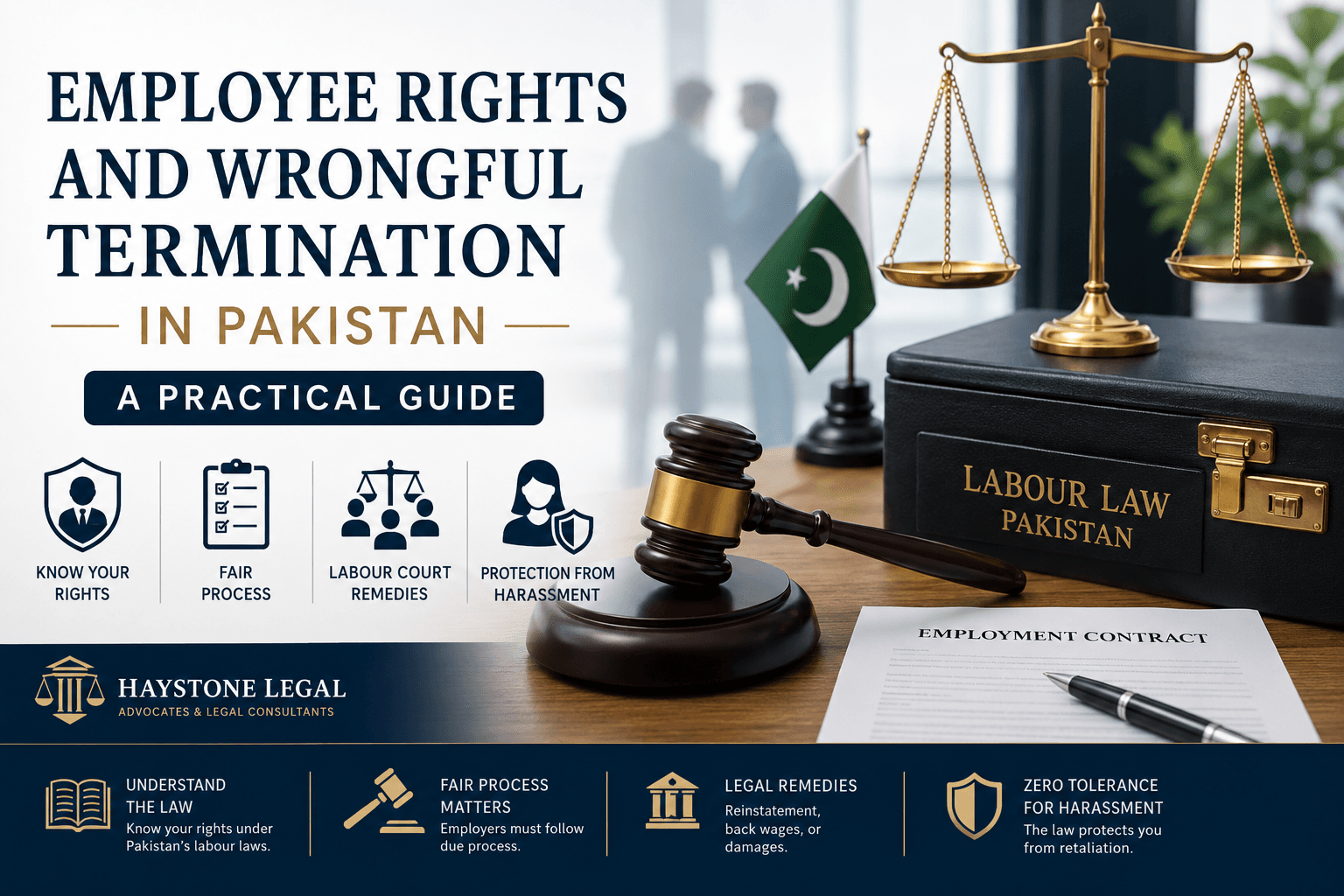
When an employee is dismissed suddenly, the first reaction is usually a mixture of shock and a vague sense that something unfair has happened. Whether that unfairness is also unlawful depends on the law, and Pakistan's labour law gives employees more protection than many employers, and many employees, assume. Pakistan is not an at-will jurisdiction where an employer can end employment on a whim. Terminations must follow a legal process, and when they do not, the law provides real remedies.
This guide explains employee rights in Pakistan and what makes a termination wrongful, along with the practical steps an employee can take. It is written for employees who have been dismissed or fear dismissal, and for employers who want to end employment correctly. One structural point shapes everything that follows: since the eighteenth constitutional amendment, labour is largely a provincial subject, so the precise statute that applies depends on where you work, while the underlying principles are broadly consistent across the provinces and the Islamabad Capital Territory. The framework includes the Industrial and Commercial Employment (Standing Orders) Ordinance 1968 and its provincial counterparts, the provincial Shops and Establishments laws, the industrial relations legislation, and the Protection against Harassment of Women at the Workplace Act 2010.
The foundation: your terms of employment
Employment in Pakistan is governed first by the contract and the applicable labour statutes, and the two work together. The Standing Orders regime requires that workers be issued clear terms, including a formal appointment letter recording the nature of employment, and it classifies workers into categories such as permanent, probationary, temporary, contract and apprentice. That classification is not a technicality; it determines the protections that apply. A permanent worker who has completed probation enjoys stronger protection against arbitrary termination than a probationer, and a worker engaged for a genuinely fixed project stands differently again. If you do not have a written appointment letter setting out your status, that absence is itself significant, and often works against the employer who failed to issue one.
The key distinction: workman versus managerial employee
Before anything else, it is necessary to identify which regime protects you, because this single distinction decides the route and the remedy. The protective labour statutes, and the labour courts that enforce them, are principally concerned with workers, sometimes described as workmen, meaning employees engaged in work that is not primarily managerial or administrative in character. Employees in genuinely managerial, administrative or supervisory roles, exercising independent judgement and authority, often fall outside the Standing Orders protections and the jurisdiction of the labour courts.
The practical consequence is significant. A worker who is wrongfully terminated can typically pursue reinstatement with back benefits through the labour forum. A managerial employee generally cannot claim reinstatement in the same way, and their remedy is more likely to lie in a civil claim for damages for breach of contract, measured by their contractual entitlements such as notice pay. What the label on your visiting card says matters far less than what you actually did, since courts look at the substance of the role, not its title. Getting this characterisation right at the outset determines everything about the strategy that follows.
Termination with notice versus dismissal for misconduct
Employers end employment in two broad ways, and the law treats them very differently.
Termination simpliciter, with notice
An employer may, in defined circumstances and subject to the applicable law and contract, terminate a worker's employment by giving the required notice or wages in lieu of notice. The Standing Orders regime typically contemplates a period of notice, commonly one month for permanent workers, or payment in its place. This is termination without an allegation of wrongdoing. Even here, the employer is not entirely free: the power cannot be used as a cloak for an unlawful motive, such as victimisation for trade union activity or discrimination, and a termination that is really a punishment dressed up as a simple termination can be challenged.
Dismissal for misconduct
Where an employer alleges misconduct, such as dishonesty, insubordination or habitual absence, dismissal is a punishment, and punishment requires due process. The recognised procedure involves issuing a charge sheet or show-cause notice setting out the allegation, giving the worker a genuine opportunity to reply, holding a proper inquiry at which the worker can be heard and can confront the case, and reaching a reasoned finding before any dismissal. A dismissal for misconduct imposed without a fair inquiry is procedurally defective and is frequently set aside by the labour courts, which will not allow serious consequences to be visited on a worker who was never given a fair chance to answer. Employers who skip the inquiry to save time routinely find that they have converted a defensible dismissal into an indefensible one.
What makes a termination wrongful
A termination may be wrongful for substantive or procedural reasons, and often both.
- No valid ground. A dismissal for misconduct that is not made out on the evidence.
- No fair procedure. Dismissal without a charge sheet, a chance to respond, and a proper inquiry.
- An unlawful motive. Termination for trade union activity, for raising a legitimate grievance, or on a discriminatory basis.
- Breach of contract or statute. Failure to give the required notice or dues, or to follow the process the law and contract require.
- Retaliation. Dismissal in response to a complaint, including a harassment complaint, which the law specifically protects against.
Where any of these is present, the worker has grounds to challenge the termination, and the labour courts have wide powers to put matters right.
Remedies: what you can claim
The remedies depend on your category and forum. For a worker within the protective regime, the labour court can, on finding a termination wrongful, order reinstatement, often with back benefits for the period of wrongful termination, effectively restoring the employment as if it had not been unlawfully ended. Alternatively, or in addition, the worker may recover their dues, such as unpaid wages, notice pay, and any earned but unpaid benefits. For a managerial employee outside that regime, the usual remedy is damages for breach of contract, measured by the contractual entitlements lost, most commonly the notice period. Separately, every departing employee is entitled to their accrued statutory and contractual dues, including earned wages, any earned leave encashment, and end-of-service benefits such as gratuity or provident fund where applicable, and these are payable regardless of the reason for leaving.
Where and how to bring a claim
The forum depends on the nature of the dispute and the province. Industrial and labour disputes are generally pursued through the labour courts and the industrial relations machinery established under the applicable industrial relations legislation, whether the federal regime for the Islamabad Capital Territory and trans-provincial establishments or the relevant provincial regime. A managerial employee's contractual claim, by contrast, is usually a civil suit. The practical path for an employee typically runs as follows.
- Raise a grievance internally. Many regimes expect, and it is in any event sensible, that the employee first raises the grievance with the employer in writing, creating a record and sometimes resolving the matter.
- Gather documents. Collect the appointment letter, salary records, any charge sheet or termination letter, and correspondence. These prove your status, your service and the manner of your termination.
- Act within time. Labour claims are subject to limitation periods, and delay can defeat an otherwise strong case, so move promptly.
- File in the correct forum. With advice, bring the claim in the labour court or the civil court as appropriate to your category and province.
Harassment, and protection from retaliation
Workplace harassment is addressed by the Protection against Harassment of Women at the Workplace Act 2010, which has been strengthened over time to broaden its definitions and reach. The Act provides a complaint mechanism, both internal to the organisation and through the Ombudsperson, and importantly it protects a complainant against retaliation. An employee dismissed in response to a genuine harassment complaint is not merely wrongfully terminated in the ordinary sense; the dismissal is an unlawful reprisal that the framework is designed to prevent and remedy. Employees should be aware that raising a protected complaint does not lawfully expose them to dismissal.
Advice for employers: how to terminate correctly
Much wrongful-termination litigation is avoidable. Employers who issue proper appointment letters, keep accurate records, use notice and payment in lieu where the law permits termination simpliciter, and conduct a real inquiry before any dismissal for misconduct, are in a far stronger position. Documenting the reason, following the process, and paying the departing employee their dues promptly is not only lawful but cheaper than defending a claim that the shortcut created. Ending employment is a legal act, and treating it as one protects the organisation as much as the employee.
Common mistakes
- Assuming employment is at-will. It is not; terminations must follow the law and the contract.
- Dismissing for misconduct without an inquiry. The most common procedural defect, and the easiest for a court to correct.
- Misjudging the workman or managerial line. This decides the forum and the remedy, and the substance of the role controls, not the title.
- Sitting on a claim. Limitation periods are real; late claims are lost.
- Ignoring final dues. Earned wages, leave and end-of-service benefits are payable regardless of the reason for departure.
- Retaliating against a complaint. Dismissing an employee for a protected complaint compounds the wrong.
Frequently asked questions
Can my employer fire me without notice in Pakistan?
Generally no. For a worker, termination usually requires notice or wages in lieu, and dismissal for misconduct requires a fair inquiry. Summary dismissal without process is open to challenge, and Pakistan does not have at-will employment.
What is the difference between a workman and a managerial employee?
A workman is broadly an employee whose work is not primarily managerial or administrative, and who enjoys the protections of the labour statutes and access to the labour courts, including possible reinstatement. A managerial employee typically falls outside that regime and usually claims damages for breach of contract instead. Courts look at what you actually did, not your job title.
Can I get my job back if I was wrongfully terminated?
A worker within the protective regime can seek reinstatement, often with back benefits, through the labour court. A managerial employee generally cannot claim reinstatement and instead pursues damages, most commonly measured by the notice period.
How long do I have to file a claim?
Labour claims are subject to limitation periods, and they can be short, so it is important to act promptly. Delay can defeat an otherwise strong case.
What should I do immediately after being terminated?
Collect your appointment letter, salary records, and any charge sheet or termination letter, raise your grievance in writing, and take advice quickly on your category, your forum and the time limits that apply.
Am I protected if I complain about harassment?
Yes. The Protection against Harassment of Women at the Workplace Act 2010 provides a complaint mechanism and protects complainants against retaliation, so a dismissal in response to a genuine complaint is unlawful.
Key takeaways
- Pakistan is not at-will: terminations must follow the contract and the applicable labour law.
- The workman versus managerial distinction decides your forum and your remedy, and the substance of your role controls.
- Termination with notice differs fundamentally from dismissal for misconduct, which requires a charge sheet, a hearing and a proper inquiry.
- Remedies range from reinstatement with back benefits for workers to damages for managerial employees, plus final dues in every case.
- Act within the limitation period, keep your documents, and take early advice.
Know your position before you act
HAYStone Legal advises employees and employers on terminations, disciplinary inquiries, labour court claims, harassment complaints and end-of-service dues. If you have been dismissed, fear dismissal, or need to end employment correctly, read about our employment and labour practice, review your terms with our employment contract tool, and book a consultation in person, by Zoom or on WhatsApp. This article is general information about Pakistani labour law, not advice on your specific case; the applicable statute and remedy depend on your province, your role and your facts.