
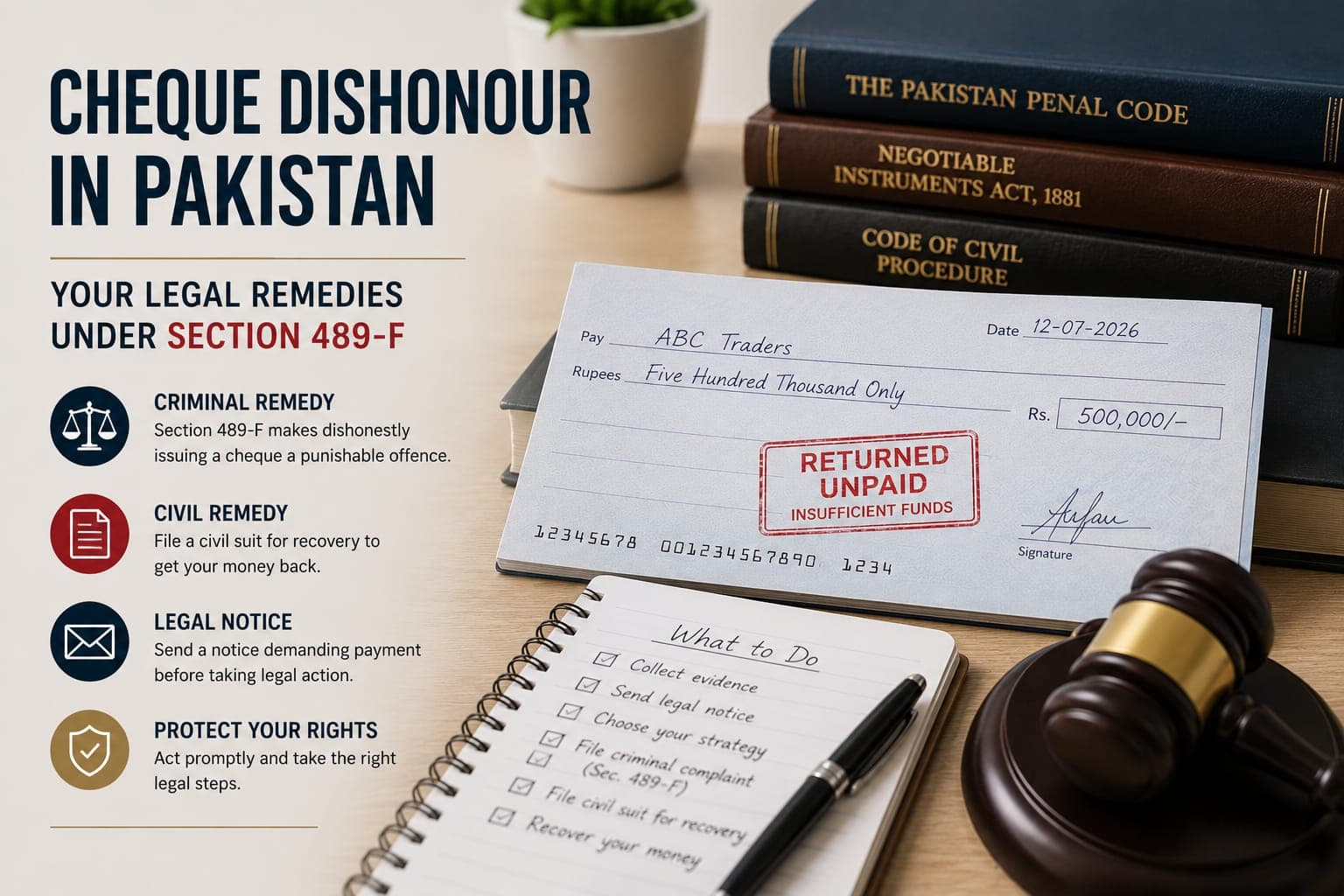
A dishonoured cheque sits at the awkward intersection of commerce and crime. To the person left holding it, a bounced cheque feels like theft. To the law, it can be a criminal offence, a civil debt, or both at once, and the remedy you choose determines whether you punish the person who wronged you, actually recover your money, or do both. Understanding that distinction at the outset is the difference between an effective response and wasted months.
This guide explains what the law does when a cheque is dishonoured in Pakistan, focusing on section 489-F of the Pakistan Penal Code and the parallel civil route for recovery. It is written for business owners, lenders, landlords and anyone who has taken a cheque and seen it returned unpaid. The relevant framework includes the Pakistan Penal Code, the Negotiable Instruments Act 1881 and the Code of Civil Procedure.
Two separate questions: punishment and recovery
The first thing to understand is that Pakistani law treats a bounced cheque as raising two different questions, answered through two different processes.
- Should the issuer be punished? This is the criminal question, addressed by section 489-F of the Penal Code, which makes the dishonest issuance of a cheque that is then dishonoured a criminal offence.
- How do I get my money back? This is the civil question, addressed by a suit for recovery, often as a summary suit on a negotiable instrument, which results in a decree you can execute against the debtor.
These are not alternatives so much as complementary tools. The criminal case creates pressure and accountability; the civil case produces an enforceable order for payment. Many creditors pursue both, but it is important to know that a conviction under 489-F does not, by itself, hand you your money. That is what the civil suit is for.
Section 489-F explained
Section 489-F provides, in essence, that whoever dishonestly issues a cheque towards repayment of a loan or the fulfilment of an obligation, and the cheque is dishonoured, commits an offence punishable with imprisonment which may extend to three years, or with a fine, or with both. The provision was introduced to give teeth to the culture of payment by cheque, so that a cheque is treated as a serious promise rather than a delaying tactic.
Two elements deserve emphasis, because cases turn on them. The first is that the cheque must have been issued towards repayment of a loan or fulfilment of an obligation. A cheque given as a pure gift, or a cheque that was never connected to a real liability, does not fit the section in the same way. The second is the word dishonestly. The offence is not committed simply because a cheque bounced for an innocent reason; the prosecution must establish the dishonest state of mind that the section requires. Courts have repeatedly stressed that section 489-F is a penal provision aimed at dishonesty, not a mechanical debt-collection device, and this is both a limit on its use and a shield for a genuinely disputed defendant.
What section 489-F does not do
It is a mistake, and a common one, to file a 489-F complaint expecting the court to order the accused to pay you. The criminal court's function is to try the offence and, on conviction, to impose imprisonment or a fine. Recovery of the underlying amount is pursued separately through the civil courts. Treating the criminal case as a substitute for the civil suit is how creditors end up with a sense of vindication but an empty pocket.
The civil route: recovering your money
To recover the sum, you file a civil suit for recovery. Where the claim is based on a written instrument such as a cheque, it can often be brought as a summary suit under the special procedure in the Code of Civil Procedure designed for negotiable instruments. The advantage of the summary procedure is speed and structure: the defendant cannot defend as of right but must seek the court's leave to defend, and where there is no genuine triable defence, judgment can follow more quickly than in an ordinary suit. If you obtain a decree, you then execute it against the debtor's assets. For many creditors, the civil suit, not the criminal complaint, is the route that actually produces payment.
Step by step: what to do when a cheque bounces
Step 1: Secure the evidence
Keep the original dishonoured cheque and the bank's cheque return memo, which states the reason for dishonour, such as insufficient funds. Preserve the record of the underlying transaction: the loan, the invoice, the agreement or the correspondence that shows why the cheque was given. Your case, criminal or civil, rests on proving both the obligation and the dishonour, so the paperwork is the foundation.
Step 2: Send a legal notice
Before rushing to court, a formal legal notice to the issuer is usually the sensible first move. It sets out the transaction, the cheque, the dishonour and your demand for payment within a stated time, and it puts the issuer on notice that you will pursue criminal and civil remedies if they do not pay. A well-drafted notice resolves a large share of cases, because it signals seriousness and gives an honest debtor a clean opportunity to settle. Our legal notice generator can help you produce a structured first draft to review with counsel.
Step 3: Decide your strategy
If the notice does not produce payment, decide, ideally with advice, whether to pursue the criminal complaint under 489-F, the civil recovery suit, or both. The right combination depends on your objective, the strength of your evidence of dishonesty, the amount at stake and the debtor's ability to pay. A creditor who mainly wants the money leans on the civil suit; one who is also confronting clear dishonesty adds the criminal complaint for pressure and accountability.
Step 4: Initiate proceedings
For the criminal route, a complaint is pursued in the competent court in accordance with the applicable procedure. For the civil route, the recovery suit is filed in the court with jurisdiction over the amount and the parties. From there the processes run on their own tracks, and it is common for the existence of a criminal case to encourage settlement of the civil claim, and vice versa.
Defences: what the issuer may argue
If you are on the receiving end of a 489-F complaint, or if you are a creditor anticipating the defence, it helps to know the arguments that are commonly run.
- No underlying loan or obligation. Because the section requires the cheque to have been issued towards a loan or obligation, a defendant may argue that no such liability existed.
- The cheque was security, not payment. Where a cheque was handed over as a guarantee or security rather than towards the discharge of a due liability, defendants argue that the section is not attracted; this is a genuinely contested area and turns on the facts.
- Absence of dishonesty. Since the offence hinges on dishonest issuance, a defendant may show that the dishonour was innocent, or that the dispute is a bona fide commercial one rather than a dishonest default.
- Misuse of a blank or stolen cheque. A defendant may allege that the cheque was blank, lost or misused, which puts the complainant to strict proof of the transaction.
None of these defences is automatic, and each depends on evidence. Their existence is a reminder that section 489-F is not a rubber stamp: the complainant must prove the case, and a defendant with a genuine dispute is not without answers.
Can these cases be settled?
Yes, and many are. A dishonoured-cheque dispute is at heart about money, and payment usually resolves it. Where the parties reach a settlement, the civil claim is satisfied by payment, and the criminal proceeding is capable of being compounded and brought to a close in accordance with the applicable law and the court's process. In practice, the combined weight of a criminal complaint and a civil suit is what brings many reluctant debtors to the table, which is why an integrated strategy often works better than either route alone.
Practical advice to avoid the problem
- Document the transaction. A cheque supported by a clear written agreement or invoice is far easier to enforce than one handed over informally.
- Note the purpose. Being able to show that the cheque was towards a specific liability strengthens both routes.
- Act promptly. Move quickly after dishonour; delay weakens the sense of urgency and can complicate limitation.
- Keep originals safe. The original cheque and return memo are your primary evidence; do not part with them.
- Take advice on strategy. The choice between and combination of criminal and civil action is where good advice pays for itself.
Frequently asked questions
Is bouncing a cheque a criminal offence in Pakistan?
It can be. Under section 489-F of the Penal Code, dishonestly issuing a cheque towards a loan or obligation that is then dishonoured is an offence punishable with up to three years' imprisonment, a fine, or both. The prosecution must prove dishonesty; an innocent dishonour is not automatically an offence.
Will a 489-F case get my money back?
Not by itself. The criminal court punishes the offence; it does not order repayment of the cheque amount. To recover the money you file a civil suit for recovery, often as a summary suit on the cheque, and then execute the decree.
Should I file a criminal case, a civil case, or both?
It depends on your goal and evidence. If recovery is the priority, the civil suit is essential. The criminal complaint adds pressure and accountability where there is clear dishonesty. Many creditors pursue both in a coordinated way.
What if the cheque was given only as security?
Defendants often argue that a cheque given as security or guarantee, rather than towards discharge of a due liability, does not attract section 489-F. This is a contested area that turns on the facts and the evidence of the transaction.
Can the matter be settled out of court?
Yes. Payment resolves most of these disputes. A settlement satisfies the civil claim, and the criminal proceeding can be compounded and closed in accordance with the applicable procedure.
What evidence do I need?
The original cheque, the bank's dishonour memo, and proof of the underlying loan or obligation, such as an agreement, invoice or correspondence. The stronger the record of both the liability and the dishonour, the stronger your case on either route.
Key takeaways
- A bounced cheque raises two questions: punishment, under section 489-F of the Penal Code, and recovery, through a civil suit.
- Section 489-F requires a cheque issued dishonestly towards a loan or obligation; it is a penal provision, not an automatic debt-collection tool.
- A criminal conviction does not return your money; the civil recovery suit, often a summary suit on the cheque, is what produces an enforceable order.
- Start with strong evidence and a formal legal notice, then choose criminal action, civil action, or both.
- Most of these disputes settle once payment is made, and a coordinated strategy often brings that about.
Recover what you are owed
HAYStone Legal acts for creditors and defendants in dishonoured-cheque matters, from the first legal notice through criminal complaints under section 489-F and civil recovery suits to execution. If a cheque given to you has bounced, or you are facing a complaint, read about our banking and finance practice, prepare a first legal notice, and book a consultation in person, by Zoom or on WhatsApp. This article is general information about Pakistani law, not advice on your specific matter; the right strategy depends on your evidence, the amount and the other side's conduct.